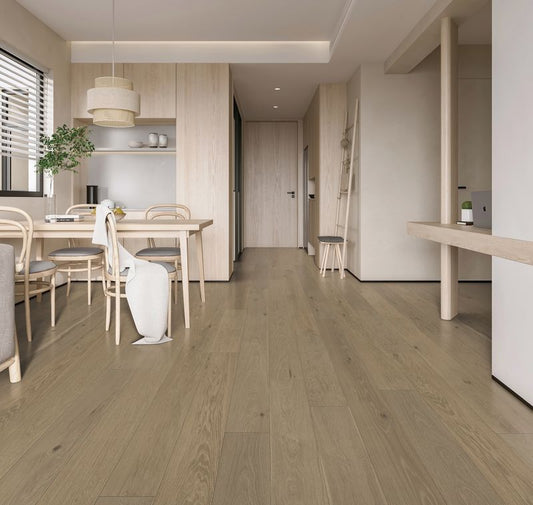
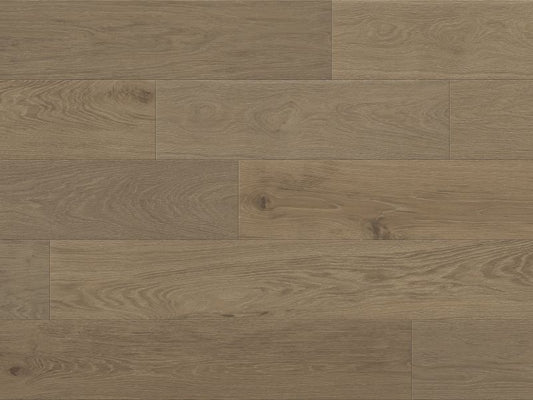
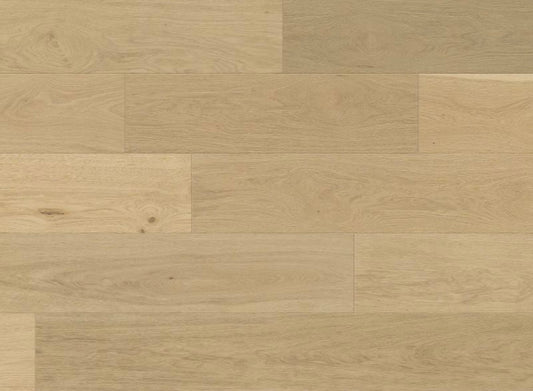
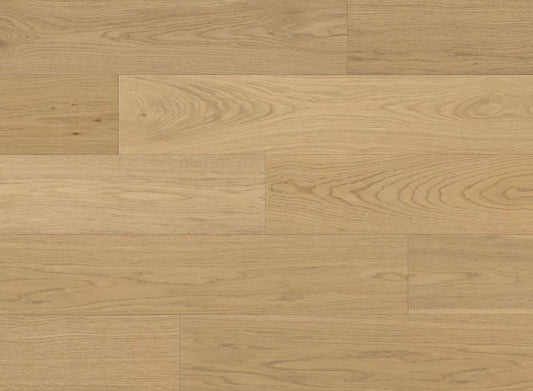
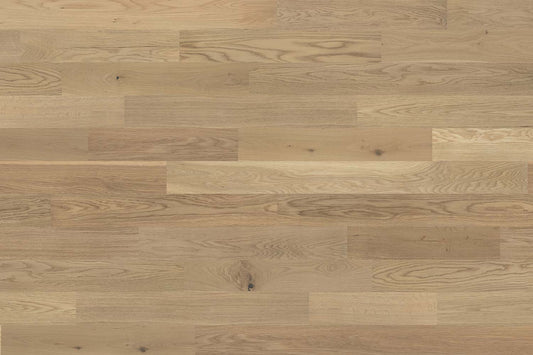
1/2-Inch Engineered Hardwood Flooring
One-half-inch engineered hardwood flooring combines a genuine hardwood surface with a supporting engineered core and a total plank profile measuring approximately half an inch.
The half-inch measurement describes the complete plank, not the hardwood veneer alone. Depending on the manufacturer, a product may be published as 1/2 inch, 12 millimeters, 12.7 millimeters, 13 millimeters, or another nearby nominal dimension. Exact measurements should remain visible so buyers can assess transitions and finished-floor height accurately.
Understanding Half-Inch Construction
A typical half-inch engineered plank may contain:
- Factory-applied protective finish
- Genuine hardwood veneer
- Supporting plywood or hardwood core
- Stabilizing backing layer
- Tongue-and-groove or locking edges
- Manufacturer-specific balancing layers
Construction varies substantially between products. Two floors with the same total thickness can have different veneer depths, cores, widths, lengths, finishes, and installation approvals.
Half-Inch Versus Veneer Thickness
Total thickness and veneer thickness describe different parts of the plank.
Total thickness includes:
- Hardwood surface
- Core
- Backing
- Factory finish
- Structural layers
Veneer thickness describes only the genuine hardwood above the core. Buyers should never assume that a half-inch floor has a half-inch wood veneer.
Benefits of a Half-Inch Profile
Depending on the complete product, potential advantages may include:
- Genuine hardwood appearance
- Moderate assembly height
- Wide-plank availability
- Long-plank options
- Multiple species and finishes
- Glue-down installation where approved
- Floating installation where approved
- Nail-down installation where approved
- Compatibility with selected renovations
- Easier coordination with nearby surfaces
Thickness alone does not guarantee durability, stability, refinishing potential, or installation suitability.
Half-Inch Versus 3/8-Inch Flooring
A half-inch plank contains more total material than a 3/8-inch plank, but the additional thickness may be located in the veneer, core, backing, or a combination of layers.
Compare:
- Veneer depth
- Core quality
- Plank width
- Plank length
- Edge profile
- Installation methods
- Fastener requirements
- Subfloor approval
- Finish system
- Finished-floor height
A well-designed 3/8-inch product may be more suitable than an incompatible half-inch product.
Half-Inch Versus 5/8-Inch Flooring
Five-eighths-inch flooring is approximately one-eighth inch thicker than a nominal half-inch plank.
The added material may affect:
- Transition profiles
- Door clearance
- Stair nosing
- Appliance openings
- Adjacent tile
- Existing hardwood
- Fastener length
- Overall assembly height
The thicker option is not automatically higher quality. Review the complete specification.
Veneer Thickness and Refinishing
Half-inch engineered hardwood may use different veneer depths. Some products may have thin decorative veneers, while others may provide more substantial genuine wood surfaces.
Professional refinishing potential depends on:
- Veneer thickness
- Texture depth
- Bevel depth
- Finish chemistry
- Damage depth
- Remaining wood above the tongue
- Installation method
- Manufacturer guidance
Screening or recoating may sometimes refresh a finish without fully sanding the wood. Obtain professional advice for the exact product.
Finished-Floor Height
A half-inch plank can be useful when coordinating with nearby materials, but the plank is only one component of the installed assembly.
Additional height may come from:
- Adhesive
- Underlayment
- Vapor-control membranes
- Acoustic layers
- Subfloor panels
- Patching compounds
- Radiant-heating assemblies
Measure finished height at doorways, stairs, vents, fireplaces, cabinets, appliances, and adjoining floors.
Installation Methods
Selected half-inch products may support:
- Full-spread glue-down
- Floating installation
- Nail-down
- Staple-down
- Glue-assisted fastening
A relatively thin tongue or edge profile may require specific fasteners, tools, or installation pressures. Do not assume nailer settings used for thicker flooring are appropriate.
The manufacturer’s method, substrate, and grade-level approvals must all align.
Concrete Installation
Selected half-inch engineered hardwood can be installed over concrete through an approved glue-down or floating method.
Concrete preparation may require:
- Moisture testing
- Flatness correction
- Crack assessment
- Surface-strength evaluation
- Vapor protection
- Approved adhesive
- Approved underlayment
- Contaminant removal
- Climate control
- Grade-level confirmation
Engineered construction does not eliminate slab moisture risk.
Wood Subfloor Installation
A wood subfloor should be dry, flat, structurally sound, and securely fastened.
Confirm:
- Panel material
- Panel thickness
- Joist spacing
- Deflection
- Moisture content
- Fastener holding ability
- Existing-floor compatibility
- Adhesive compatibility
- Grade level
- Expansion requirements
Loose panels and squeaks should be corrected before installation.
Wide-Plank Half-Inch Flooring
Some half-inch products use wide and long board dimensions. Plank width should be evaluated separately from thickness.
Wide boards may require:
- Tighter flatness control
- Adhesive assistance
- Stable indoor humidity
- Specific fastening patterns
- Increased handling care
- Additional layout planning
A half-inch profile does not exempt wide flooring from product-specific requirements.
Door and Appliance Clearance
Renovation projects should measure:
- Entry doors
- Interior doors
- Sliding doors
- Dishwashers
- Refrigerators
- Ranges
- Floor vents
- Toe kicks
- Stair components
- Built-in cabinets
Plan adjustments before installation rather than discovering clearance problems after the floor is complete.
Moisture and Humidity
Half-inch engineered hardwood remains genuine wood. Maintain the required temperature and relative humidity throughout the flooring’s service life.
Poor conditions may contribute to:
- Gapping
- Cupping
- Crowning
- Surface checking
- Edge movement
- Finish stress
- Delamination
- Permanent damage
Cleaning and Care
Use only products approved for the specific finish. Routine care may include vacuuming grit, damp cleaning with an approved cleaner, prompt spill removal, furniture protection, suitable mats, and humidity control.
Avoid steam mops, standing water, abrasive pads, and unapproved polish.
Frequently Asked Questions
What does half-inch engineered hardwood mean?
It means the complete plank measures approximately one-half inch thick.
Is the hardwood veneer half an inch thick?
No. The veneer is only one component of the complete plank.
Is 12 millimeters the same as half an inch?
It is close but not exact. One-half inch equals 12.7 millimeters.
Is half-inch engineered hardwood thick enough?
It can be suitable when its complete construction and installation approval match the project.
Can it be nailed down?
Selected half-inch products can be nailed or stapled using specified fasteners.
Can it be installed over concrete?
Selected products may be glued or floated over prepared concrete when approved.
Can half-inch hardwood be refinished?
Potential depends primarily on veneer thickness, texture, and manufacturer guidance.
Does it require underlayment?
Floating products commonly require approved underlayment. Other methods have different requirements.
Is half-inch hardwood waterproof?
No. Genuine hardwood requires moisture management.
What should buyers compare besides thickness?
Compare veneer, core, species, plank dimensions, finish, installation method, moisture limits, and grade-level approval.